commercial

Director duties

There are numerous and important legal responsibilities imposed on directors of companies under the Corporations Act 2001 and other laws, including the general law.

Of these director duties, some of the most significant are contained in Chapter 2D of the Corporations Act:

  • to exercise the degree of care and diligence that a reasonable person might be expected to show in the role – the business judgment rule (s.180).
  • to act in good faith in the best interests of the company and for a proper purpose (s.181)
  • to not improperly use their position to gain an advantage for themselves or someone else, or to the detriment to the company (s.182)
  • to not improperly use the information they gain in the course of their director duties to gain an advantage for themselves or someone else, or to the detriment to the company (s.183)
  • to lodge information with ASIC (s.188)

but there are others, including to:

  • to avoid conflicts of interest between the interests of the company and their personal interests and to reveal and manage conflicts if they arise (s.191)
  • to take reasonable steps to ensure that a company complies with its obligations in the Corporations Act related to the keeping of financial records and financial reporting (s.344)
  • to ensure that a company does not trade whilst insolvent or where they suspect it might be insolvent (eg, if it is unable to pay its debts as and when they fall due) (s.588G)
  • if the company is being wound up, to assist the liquidator and provide accurate details of the company’s affairs.

Directors can also be liable for unpaid taxation obligations and unpaid superannuation monies – for which the ATO can issue Director Penalty Notices.

Failing to comply with director duties can result in criminal sanctions, fines, disqualification from acting as a director and other consequences, such as breach of contract such as obligations under a Directors & Shareholders Agreement.

People can be responsible as directors even if not formally appointed

What many people don’t know is that the term “director” is defined in section 9 of the Corporations Act to include a person:

  • who is appointed as a director (or alternate director), regardless of the name given to their position; and
  • even though not validly appointed and recorded at ASIC as a director:
    • who acts in the position of a director (also known as a ‘de facto director‘); or
    • whose instructions or wishes the appointed directors are accustomed to act in accordance with (also known as a ‘shadow director’)

Commonly used terms for the titles of ‘director’ include ‘non-executive director‘, ‘executive director‘, ‘managing director‘, ‘independent director‘ and ‘nominee director‘.

Often, businesses give titles to employees rather than pay rises. Similar considerations apply to partnerships, where some partners are ‘salaried partners‘, not ‘equity partners‘ so they take home a salary rather then enjoy the fruits of the business. What these ‘salaried partners‘ (in the same vein as ‘non-executive directors‘) often fail to understand or appreciate is that they are holding themselves out as directors or partners of the business and can have full responsibility as “shadow directors”  if something goes wrong, such as an insolvency.

How to meet the responsibilities

Those with key roles in any business, regardless of its legal form, you should:

  • understand your legal obligations and make compliance with them part of your business
  • keep informed about your business’ financial position and performance, ensuring that it can pay its debts on time and keeps proper financial records
  • give the interests of the business, its stakeholders/owners and its creditors top priority, which includes acting in the business’ best interests (even if this may not be in your own interests)
  • use information you get through your position properly and in the best interests of the business
  • get professional advice or more information if you are in doubt.

FURTHER INFORMATION

Craig Pryor is principal solicitor at McKillop Legal. For further information in relation to Corporations Act or corporate governance issues or any business or commercial law matter, contact Craig Pryor on (02) 9521 2455 or email craig@mckilloplegal.com.au

This information is general only and is not a substitute for proper legal advice. Please contact McKillop Legal to discuss your needs.

Stay up to date – LinkedIn Facebook Twitter

Minimum wage increase

The Fair Work Commission has, by the National Minimum Wage Order 2018, increased minimum wages by 3.5% from the first pay period starting on or after 1 July 2018.

This minimum wage increase applies to all employees paid the national minimum wage – employees will be entitled to a minimum take-home weekly pay of $719.20, or $18.93/hour.

Employers should review the pay rates of all employees to ensure that they are being paid at or above the appropriate pay rate.

A review should also be undertaken to ensure those employees on “annualized salaries” remain appropriately remunerated.

Employment contracts

If your business has not done so recently, it may be a good time to update any Employment Contracts to ensure that they cover important issues such as Restraints of Trade and consider any amendments to Workplace Policies

Further information

If you would like any more information in relation to employment law, disputes or business issues generally, please contact Craig Pryor on (02) 9521 2455 or email craig@mckilloplegal.com.au

This information is general only and is not a substitute for proper legal advice. Please contact McKillop Legal to discuss your legal concerns or objectives.

Stay up to date – LinkedIn Facebook Twitter | McKillop Legal Blog

Country of origin food labelling

From 1 July 2018, most of the foods you buy will need to display new country of origin labels. This is required to comply with the Country of Origin Food Labelling Information Standard 2016.

Different labelling requirements apply depending on:

  • whether the food is grown, produced, made or packed in Australia or another country
  • whether the food is a ‘priority’ or ‘non-priority’ food
  • how the food is displayed for sale

“It is illegal for a business to make a claim that goods were grown, produced, made or packed in a particular country when this was not the case.”

You will find country of origin labelling on most food you buy at the supermarket, local stores, markets, online or from a vending machine.

Food bought from restaurants, cafes, take-away shops, schools and caterers hwoever does not have to be labelled.

Food that was packaged and labelled on or before 30 June 2018 can still be sold without the new labels so there will be a transition period.

Types of food covered by the Standard

The Standard applies to most food offered for retail sale in Australia (e.g. food sold to the public in stores or markets, online or from vending machines) if it is:

  • in a package or
  • unpackaged seafood, particular meats, fruit and vegetables, nuts, spices, herbs, fungi, legumes, seeds or a mix of these foods.

The Standard does not apply to food that is:

  • otherwise unpackaged (e.g. unpackaged cheese, pastries or sandwiches)
  • only intended for export to overseas markets
  • sold by restaurants, canteens, schools, caterers, self-catering institutions, prisons, hospitals, medical institutions and at fund-raising events (e.g. a cake stall at a school fete)
  • made and packaged on the same premises where it is sold (e.g. bread in a bakery)
  • delivered and packaged ready for consumption, as ordered by the consumer (e.g. home delivered pizza)
  • for special medical purposes
  • not for human consumption (e.g. pet food).

Grown in, produced in, made in or packed in?

The key country of origin claims mean different things:

  • “Grown in” is a claim about where the ingredients come from and is commonly used for fresh food. It can also be used for multi-ingredient products to show where the food was grown and processed
  • “Produced in” is a claim about where the ingredients come from and where processing has occurred. This claim is often used for processed, as well as fresh foods
  • “Made in” is a claim about the manufacturing process involved in making the food

When a food has not been grown, produced or made in a single country, it will need to display a label identifying the country it was “packed in”.

It is illegal for a business to make a claim that goods were grown, produced, made or packed in a particular country when this was not the case.

Priority and non-priority goods

“Non-priority foods” must carry a country of origin statement about where the food was grown, produced, made or packed.

A product is a non-priority food if it belongs to one of the following 7 categories:

  • seasoning (e.g. salt, spices and herbs)
  • confectionery (e.g. chocolate, lollies, ice cream, popcorn)
  • tea and coffee (in dry, or ready to drink, form)
  • biscuits and snack food (e.g. chips, crackers and ready to eat savoury snacks)
  • bottled water
  • soft drinks and sports drinks
  • alcohol

Everything else is a “priority food”. For example, priority foods include fruit, vegetables, meat, seafood, bread, milk, juice, sauces, honey, nuts and cereal.

Priority foods can only claim to be “produced” or “grown” in Australia if they contain 100% Australian ingredients.

If a priority food was grown, produced or made in Australia, its country of origin label will also feature:

  • a kangaroo in a triangle logo to help you quickly identify that the food is Australian in origin;
  • a bar chart and text identifying the proportion of Australian content in the food (if any).

Businesses may voluntarily choose to provide country of origin information for food that is exempt from the Standard, provided it is not false or misleading.

However, if a business wishes to use the kangaroo logo or the bar chart on food products to be sold in Australia, they will be required to comply with the Standard regarding the use of those graphics.

Labels

The Standard sets out 3 possible country of origin labels for food, each with its own mandatory text requirements:

Three component standard mark – a graphic and text-based label which is mandatory for priority food items grown, produced or made in Australia. The label includes:

  • the kangaroo in a triangle symbol so you can easily and quickly identify the food’s Australian origin
  • the minimum proportion, by ingoing weight, of Australian ingredients, indicated by a percentage amount and shown in a bar chart
  • a statement indicating what percentage of the food was grown or produced in Australia
Three component label


Two component standard mark – a graphic and text-based label which is mandatory for most priority food items packed in Australia. It may also be used for imported priority foods that contain Australian ingredients. The label includes:

  • the minimum proportion, by ingoing weight, of Australian ingredients, indicated by a percentage amount and shown in a bar chart
  • a statement indicating what percentage of the food was grown or produced in Australia
The bar chart indicates what percentage of the product is Australian made, and the explanatory text spells this out in simple terms.


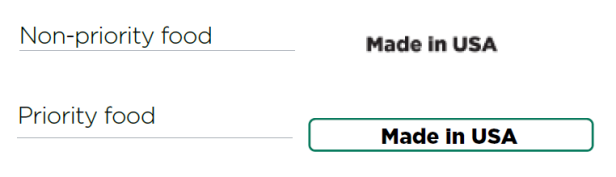
Country of origin statement – a text-only label which is used for non-priority food items. Imported priority foods must also, as a minimum, carry a country of origin statement in a clearly defined box. 
The country of origin statement indicates where the product was made

Other claims

Sometimes businesses add words, or easily recognisable logos, symbols or pictures to their food packaging, which could suggest or imply a connection between the product and a particular country. For example, a statement such as ‘Proudly Australian owned’ next to an Australian flag tells you about the ownership of the company.

Businesses must ensure that any such representations made about their products are clear, truthful and accurate.

FURTHER INFORMATION

Craig Pryor is principal solicitor at McKillop Legal. For further information in relation to consumer rights, business or commercial law matter, contact Craig Pryor on (02) 9521 2455 or email craig@mckilloplegal.com.au

This information is general only and is not a substitute for proper legal advice. Please contact McKillop Legal to discuss your needs.

Stay up to date – LinkedIn Facebook Twitter

Downsizer superannuation contributions

*The contents of this article are general in nature – as always, you should seek financial planning advice before doing anything to alter your financial position.*

From 1 July 2018, the Australian Government will allow “downsizer contributions” into superannuation as part of a package of reforms aimed at reducing pressure on housing affordability in Australia.

This measure applies where the exchange of contracts for the sale of your home (which must be your principal place of residence) occurs on or after 1 July 2018.

If you are 65 or older, and you meet the eligibility requirements, you may be able to choose to make a “downsizer contribution” from the proceeds of selling your home into your superannuation account for an amount of potentially up to $300,000.

Importantly, your downsizer contribution is not a non-concessional contribution and will not count towards your contributions cap, nor do the normal contributions rules apply, such as the “works test”.

Downsizer contributions are not tax deductible and will be taken into account for determining your eligibility for the age pension.

If you do not meet the “downsizer contribution” requirements, then the contribution will be assessed under the normal contributions caps (and penalties may apply).

If considering a downsizer contribution, you should also look to ensure that your estate plan is appropriate and if not, put appropriate arrangements in place.

From 1 July 2018, the Australian Government will allow “downsizer superannuation contributions

ELIGIBILITY

You will generally be eligible to make a downsizer contribution to super if you can answer “yes” to all of the following:

  • you are 65 years old or older at the time you make a downsizer contribution (there is no maximum age limit),
  • the amount you are contributing is from the proceeds of selling your home where the contract of sale was exchanged on or after 1 July 2018,
  • your home was owned by you (or your spouse) for at least 10 years prior to the sale,
  • your home is in Australia (and is not a caravan, houseboat or other mobile home),
  • the proceeds (capital gain or loss) from the sale of the home are either exempt or partially exempt from capital gains tax (CGT) under the main residence exemption, or would be entitled to such an exemption if the home was a CGT, rather than a pre-CGT (acquired before 20 September 1985) asset,
  • you have provided your super fund with the downsizer contribution form, either before or at the time of making your downsizer contribution,
  • you make your downsizer contribution within 90 days of receiving the proceeds of sale, which is usually the date of settlement, and
  • you have not previously made a downsizer contribution to your super from the sale of another home.

HOW MUCH CAN YOU MAKE AS A DOWNSIZER CONTRIBUTION?

If you are eligible to make a downsizer contribution, there is a maximum amount of $300,000 that can be made.

The contribution amount can’t be greater than the total proceeds of the sale of your home.

It only applies to the sale of your main residence, and you can only use it for the sale of one home. You can’t access it again for the sale of a second home, but there is also no requirement to purchase another home.

TIMING

You must make your downsizer contribution within 90 days of receiving the proceeds of sale. This is usually at the date of settlement.

You may make multiple “downsizer contributions” from the proceeds of a single sale however:

  • they must be made within 90 days of the date you receive the sale proceeds (usually the settlement date of the sale), and
  • the total of all your contributions must not exceed $300,000 (or the total proceeds of the sale less any other downsizer contributions that have been made by your spouse).

If circumstances outside your control prevent payment within that time, you can seek an extension of time.

HOW TO MAKE A DOWNSIZER CONTRIBUTION

Before you decide to make a downsizer contribution, you should:

  • obtain financial planning advice in relation to the relevant requirements and any effect on your social security benefits or other entitlements (there may be other things to consider with any surplus sale proceeds such as acquiring a “granny flat right” and updating your estate planning documents),
  • check the eligibility requirements for making a downsizer contribution,
  • contact your super fund to check that it will accept downsizer contributions, and
  • complete a downsizer contribution form for each downsizer contribution and provide this to your super fund when making – or prior to making – each contribution

FURTHER INFORMATION

Craig Pryor is principal solicitor at McKillop Legal. For further information in relation to estate planning, business succession, superannuation or SMSFs, contact Craig Pryor on (02) 9521 2455 or email craig@mckilloplegal.com.au.

This information is general only and is not a substitute for proper legal advice. Please contact McKillop Legal to discuss your needs.

Stay up to date – LinkedIn Facebook Twitter

SMSF owns property. Member dies. Oh oh!

Do you, like many Australians, have a self managed superannuation fund (SMSF)?

If you want to own direct investments within your superannuation or have greater control of your superannuation portfolio, a SMSF can be a suitable alternative to retail superannuation funds.

SOME ADVANTAGES OF SMSFs

SMSFs have:

  • direct investment choice
  • access to wholesale managed funds
  • the benefit of being able to combine the superannuation balances of up to 6* people
  • the advantage of 15% taxation on investment earnings (as opposed to marginal or company tax rates) and potentially reduced capital gains tax
  • the ability to assist with estate planning and possibly for non-lapsing binding death benefit nominations

DIRECT PROPERTY

Often seen as a key advantage is the ability of an SMSF to invest in direct property, such as owning office or factory space from which a business operates from (assuming your SMSF’s Investment Strategy allows for direct property).

Where member balances are insufficient to buy a property outright, SMSFs can also borrow but only using a limited recourse borrowing arrangement (LRBA) using a bare trustee that holds the property on behalf of the SMSF for the duration of the loan and once the debt is paid, the legal ownership of the property passes to the SMSF.

Property values hopefully go up over the next 20 or so years and the members benefit from and can live happily off the benefits during retirement …

… well that’s the plan anyway. So, what happens if a member dies or gets really sick a few years into the plan? (hint – it can ruin everything, for the other members).

CONSEQUENCES OF DEATH OR TPD

On the death of a member, that member’s superannuation balance is to be paid out (to the member’s estate of their nominated beneficiary/ies) as soon as is practicable.

On the total and permanent disablement (TPD) of a member, the member may be able to exit from the SMSF and call for their member balance to be paid out.

… but if the SMSF’s cash is all tied up in the property and the property is still subject to the LRBA, where does the money come from to pay out the member balance?

The property may have to be sold to fund this! That is, unless there is a SMSF Member Death & TPD Exit Deed in place.

SMSF MEMBER DEATH & TPD EXIT DEED

A SMSF Member Death & TPD Exit Deed can help in reducing the financial effects arising from the unexpected death or TPD of a member by for example:

  • requiring the SMSF members to effect a life insurance policy over the lives of the other members and where there is a death and a payout under the policy, the policy owners contribute funds to the SMSF with the intention of paying out the deceased member’s superannuation balance (and using any remainder to reduce or pay out any debt on the property under the LRBA); and
  • requiring the SMSF members to either put in place appropriate TPD cover or to agree that on the occurrence of a TPD event of a member, that member may remain a passive investor in the SMSF but cannot immediately call for payment of their member balance, even if they would otherwise be entitled to under the superannuation legislation, but rather, if they want the payment, their member balance is to be paid out over several years (ie, from the SMSF’s cashflow).

Unless there are appropriate insurances in place or an agreement for members to only get paid out benefits over time in the event of a TPD event, then the likely outcome of the death or TPD of one member is the sale of the SMSF’s property.

This can be a particularly bad problem if the SMSF has only recently acquired the property and had therefore incurred all of the legal, financial planning and accounting costs as well as stamp duty, but had no time for the asset to generate income or appreciate in value. The death or TPD of the one member therefore affects up to 3 other members who may not even be related to the affected member!

FURTHER INFORMATION

Craig Pryor is principal solicitor at McKillop Legal. For further information in relation to estate planning, business succession, superannuation or SMSFs, contact Craig Pryor on (02) 9521 2455 or email craig@mckilloplegal.com.au.

This information is general only and is not a substitute for proper legal advice. Please contact McKillop Legal to discuss your needs.

Stay up to date – LinkedIn | Facebook | Twitter

*amendment 01 July 2021 – only 4 members were allowed prior to 1 July 2021.

SMSF owns property. Member dies. Oh oh!

The Australian Consumer Law (ACL)

Since 2011, businesses that provide goods (whether by selling or leasing them) or services to consumers in Australia must comply with certain consumer guarantees (as do manufactures and importers) imposed by the Australian Consumer Law (ACL).

Businesses must provide these ACL guarantees automatically, regardless of any other warranties they give to you or sell you.

Who is a consumer?

A person – including a business – will be considered a “consumer” if:

  1. they purchase goods or services that cost less than $100,000*;
  2. the goods or services cost more than $100,000*, but they are of a kind ordinarily acquired for domestic, household or personal use or consumption; or
  3. the goods are a commercial road vehicle or trailer used primarily to transport goods on public roads.

*at the time of this article’s creation, this amount was $40,000 but increased 150% to $100,000 on 01 July 2021.

CONSUMER GUARANTEES – GOODS

Businesses that sell goods guarantee that those goods:

  • are of acceptable quality – safe, lasting, have no faults, look acceptable and do all the things someone would normally expect them to do;
  • are fit for any purpose that the consumer made known to the business before buying (either expressly or by implication), or the purpose for which the business said it would be fit for;
  • have been accurately described;
  • match any sample or demonstration model;
  • satisfy any express warranty (ie, anything promised by the business about the goods);
  • have a clear title, unless you otherwise advise the consumer before the sale;
  • come with undisturbed possession, so no one has the right to take the goods away from or to prevent the consumer from using them;
  • are free from any hidden securities or charges; and
  • have spare parts and repair facilities reasonably available for a reasonable period of time, unless the consumer is advised otherwise.

Manufacturers and importers guarantee that their goods:

  • are of acceptable quality;
  • have been accurately described;
  • satisfy any manufacturer’s express warranty; and
  • have spare parts and repair facilities reasonably available for a reasonable period of time, unless the consumer is advised otherwise.

What happens if these guarantees regarding goods aren’t met?

If a business sells a good to a customer that fails to meet one or more of the above consumer guarantees, they are entitled to a remedy – either a repair, replacement or refund and compensation for any consequential loss – depending on the circumstances.

Minor problems

Generally, if the problem is minor, the business can choose whether to remedy the problem with a replacement, repair or refund. If business chooses to repair and it takes too long, the consumer can get someone else to fix the problem and ask the business to pay reasonable costs, or reject the good and get a full refund or replacement.

Major problems

If the problem is major or can’t be fixed, the consumer can choose to:

  • reject the goods and obtain a full refund or replacement, or
  • keep the goods and seek compensation for the reduction in value of the goods.

What is “minor” and what is “major” when considering goods?

A purchased item has a major problem when it:

  • has a problem that would have stopped someone from buying the good if they had known about it;
  • is unsafe;
  • is significantly different from the sample or description;
  • doesn’t do what the business said it would, or what the consumer asked for and can’t easily be fixed.

Gift recipients are entitled to the same rights as consumers who bought the goods directly.

A business can’t refuse to provide a remedy if the good is not returned in its original packaging.

The buyer also must not refuse to deal with a customer about the returned good and tell them to deal with the manufacturer instead (however a manufacturer can be approached directly by the consumer).

CONSUMER GUARANTEES – SERVICES

Businesses that supply services to consumers guarantee that those services will be:

  • provided with due care and skill;
  • fit for any specified purpose (express or implied); and
  • provided within a reasonable time (when no time is set).

What happens if these guarantees regarding services aren’t met?

If a business sells a customer a service that fails to meet one or more of the consumer guarantees, the consumer is entitled to a remedy – for example, a refund, a further service to rectify the problem and in some circumstances compensation for consequential loss. The service provider must then provide the appropriate remedy.

Minor problems

If the problem is minor and can be fixed, the business can choose how to fix the problem.

The consumer cannot cancel and demand a refund immediately. The business must have an opportunity to fix the problem. If the repairs take too long, the consumer can get someone else to fix the problem and ask the business to pay reasonable costs, or cancel the service and get a refund.

Major problems

If the problem is major or can’t be fixed, the consumer can choose to:

  • terminate the contract for services and obtain a full refund; or
  • seek compensation for the difference between the value of the services provided compared to the price paid.

What is a “major” problem when looking at services?

A purchased service has a major problem when it:

  • has a problem that would have stopped someone from purchasing the service if they had known about it;
  • is substantially unfit for its common purpose, and can’t easily be fixed within a reasonable time;
  • does not meet the specific purpose the consumer asked for and can’t easily be fixed within a reasonable time; or
  • creates an unsafe situation.

EXCEPTIONS

A business may not be required to provide a remedy if a consumer:

  • simply changes their mind, decides they do not like the purchase or has no use for it;
  • discovers they can buy the goods or services more cheaply elsewhere; or
  • has misused the goods in a way that caused the issue or damaged the goods by using them in a way that was unreasonable.
  • knew of or was made aware of the fault before they bought the good;
  • asked for a service to be done in a certain way against the advice of the business.

HOW CAN BUSINESSES HELP THEMSELVES?

Although the consumer guarantees cannot be contracted out of, businesses can take steps to limit its effect, such as:

  • Putting in place appropriate Terms of Trade that confirm the understanding of the parties as to things that can often cause issues like time for delivery (as opposed to the unclear “reasonable” time), imposing obligations on the consumers as to how to properly use the goods/services and so on;
  • Putting in place appropriate workplace policies and employment contracts that limit the “promises” that sales staff may make about goods or services being sold;
  • Considering marketing and product/service detailed material so as to ensure the descriptions and promises about the goods and services are clear and correct and not misleading or likely to cause complaints.

FURTHER INFORMATION

Craig Pryor is principal solicitor at McKillop Legal. For further information in relation to consumer rights, business or commercial law matter, contact Craig Pryor on (02) 9521 2455 or email craig@mckilloplegal.com.au

This information is general only and is not a substitute for proper legal advice. Please contact McKillop Legal to discuss your needs.

Stay up to date – LinkedIn | Facebook | Twitter

Claim a CTP Green Slip refund

The NSW Government has reformed the compulsory third party (CTP) insurance scheme to reduce the costs of CTP Green Slips for vehicle owners and better support people injured on NSW roads.

If you were the registered owner of a private vehicle as at midnight 30 November 2017, you may be able to claim a CTP Green Slip refund for CTP insurance policies bought or renewed before 1 December 2017.

Over 4 million NSW vehicle owners will be eligible for a refund as a result of these reforms.

Claims must be submitted by 30 September 2018.

To see if you are eligible to claim a CTP Green Slip refund and to make a claim for your refund, log in to Service NSW

Do you own land in NSW through a family trust structure?

Do you own land in NSW through a family trust structure? If so, then take note…

Revenue NSW (previously the NSW Office of State Revenue) automatically applies the Land Tax Surcharge on land tax assessments for properties owned through a family trust. The surcharge, which was introduced as part of the 2016 NSW budget, is currently at 2%, and can be significant.  There is a similar application to stamp duty also.

This surcharge does not apply where Revenue NSW has been advised of the fact that the trust deed specifically (and irrevocably and permanently) excludes foreign persons or entities as potential beneficiaries.

On 24 June 2020, the State Revenue Legislation Further Amendment Act 2020 (NSW) received Royal Assent. It clarifies that a trustee of a discretionary trust owning residential property in NSW is taken to be a foreign person for foreign surcharges purposes, if the trust does not irrevocably prevent a foreign person from being a beneficiary of the trust.

The transitional provisions give trustees of discretionary trusts an exemption and refund for foreign surcharges where the trust deed, made on or before 24 June 2020, contains a provision to prevent a foreign person from benefiting.

Until 31 December 2020, trustees of discretionary trusts have an opportunity to amend their trust deeds to include the provision and the provision must be irrevocable for the past and future surcharges not to apply.

From 1 January 2021, trustees of all discretionary trusts (including testamentary trusts) will be subject to surcharges unless the trust deed contains an irrevocable provision.

We have assisted several clients to update their trust deeds at the time of initial registration for land tax (to exclude foreign persons or entities as potential beneficiaries) however, where there is an existing trust with an existing landholding, this may be something that needs to be monitored and updated, so check your assessments.

FURTHER INFORMATION

Craig Pryor is principal solicitor at McKillop Legal. For further information in relation to land tax, trust deed amendments or any other commercial law matter, contact Craig Pryor on (02) 9521 2455 or email craig@mckilloplegal.com.au.

This information is general only and is not a substitute for proper legal advice. Please contact McKillop Legal to discuss your legal needs.

Stay up to date – LinkedIn Facebook Twitter

Bringing on business partners?

For businesses that are growing and putting on other shareholders and directors, a Shareholders Agreement is a must have. If your business is not a company but it a partnership or a unit trust structure, the document would be a Partnership Deed or Unitholders Agreement.

Don’t leave some of the most important and fundamental issues for your business to chance. Consider a company with 2 or 3 shareholders – a typical small to medium sized business scenario…

COMMON PROBLEMS FOR SHAREHOLDERS

Issues that commonly that can affect shareholders include:

  • A shareholder sells their shares, leaving you with an unintended business partner;
  • A shareholder dies and you inherit an unintended business partner or you have to buy the shares from their estate for more than you ought to;
  • As a shareholder, you want out but cannot find a suitable purchaser but the other shareholders won’t buy you out;
  • The shareholders don’t have available funds to pay out an exiting shareholder;
  • The majority shareholder wishes to run the business one way, but is restricted by a minority shareholder;
  • You, as a minority shareholder, are being treated poorly by other shareholders who are running the business with little regard to your interests;
  • You wish to sell the company’s business as there is an excellent offer on the table, but another shareholder will not and is jeopardizing the sale;
  • You wish to receive dividends from the business, but others want to reinvest the profits.

The aim of a Shareholder Agreement is to bring some certainty to the business relationship so there is confidence in how the business will operate

TAILORED SOLUTIONS

A Shareholder Agreement tailors the rights and obligations of the shareholders to fit the particular purposes of the company, the nature of its business and the aims and wishes of its shareholders – to help avoid some of the potential problems identified above.

Some factors that should be considered in a Shareholders Agreement include:

  • The company’s activities/type of business – its purpose;
  • The roles and obligations of the shareholders;
  • Who are the directors and how the shareholders can change them;
  • Director remuneration;
  • Who will manage and control the business day to day, such as a managing director;
  • Meetings – how they are called, how they are run, counting of votes;
  • How decisions are made by shareholders or the board of directors;
  • What types of decisions require a simple majority, special resolution or a unanimous vote;
  • Payment of dividends;
  • Funding/borrowing;
  • Restrictions on the issue/transfer of shares and calculating the share price;
  • How shareholders can exit from the company and on what terms;
  • Funding of exits (including death) – buy/sell obligations and personal insurances;
  • Restraints on existing shareholders as to company customers etc;
  • Insurances to be taken out; and
  • How any disputes are to be resolved.

The aim of a Shareholders Agreement is to bring some certainty to the business relationship so that shareholders can have some confidence as to how the company will be run and, if there is a falling out, to provide a mechanism for that falling out to be dealt with, as painlessly as possible.

Ideally, the Shareholders Agreement would be in place from the outset whilst all parties are in agreement in relation to all issues however, they can be documented at any time (provided all parties agree).

FURTHER INFORMATION

Craig Pryor is principal solicitor at McKillop Legal. For further information in relation to starting or buying a business, drafting business documents or any other commercial law matter, contact Craig Pryor on (02) 9521 2455 or email craig@mckilloplegal.com.au.

This information is general only and is not a substitute for proper legal advice. Please contact McKillop Legal to discuss your business needs.

Stay up to date – LinkedIn | Facebook | Twitter

Creditor’s Statutory Demand

If you or your business are owed a debt by an Australian company that is not disputed, then there can be a relatively simple, yet effective way of obtaining payment in as little as 3 weeks.

The Corporations Act 2001 (Cth) provides for the issue of a document called a “creditor’s statutory demand” to any Australian company that owes a debt greater than the prescribed amount (which from 01 July 2021 is $4,000*).  *Note that this threshold increased from the original $2,000 (at the time this article was original published) to $20,000 as a result of the Coronavirus legislation, but dropped back to the current threshold.

The process is basically that the demand is served and then you wait.

Statutory demands must be in the prescribed form, detail the debt due, be signed by or on behalf of the creditor and be properly served on the company. Where the debt is not a judgment debt, an affidavit is also required to be signed, certifying that the debt is due and payable.

The Act provides where the demand is served and not complied with within 21 days*, the company is presumed to be insolvent and is liable to be wound up. Compliance with the statutory demand is achieved by either paying the debt due or coming to an arrangement satisfactory to the creditor in relation to payment of the debt within that 21 day period. (*During the COVID-19 pandemic period, this increased to 6 months but has reverted back to 21 days from 01 January 2021).

The presumption of insolvency lasts for 3 months after the 21 day period expires. Any proceedings to wind up the company on the basis that it is insolvent must be commenced within that period.

Creditor’s statutory demands may only be set aside by the Court on certain grounds and applications to do so must be both filed with the Court and served on the creditor that issued the demand within that 21 day period. Grounds for setting aside the demands are limited and include where there is a defect in the demand, where the amount owed is less than the prescribed amount or where there is a genuine dispute as to the existence and/or amount of the debt claimed. None of these grounds may be relied on to oppose a demand after the 21 day period.

Where the debt is disputed, the service of a creditor’s statutory demand is not the appropriate way to obtain payment however, there are other methods available.

FURTHER INFORMATION

For further information in relation to debt recovery, company issues or any commercial law matter, contact McKillop Legal on (02) 9521 2455 or email help@mckilloplegal.com.au.

This information is general only and is not a substitute for proper legal advice. Please contact McKillop Legal to discuss your legal concerns or objectives.

Stay up to date – LinkedIn Facebook Twitter