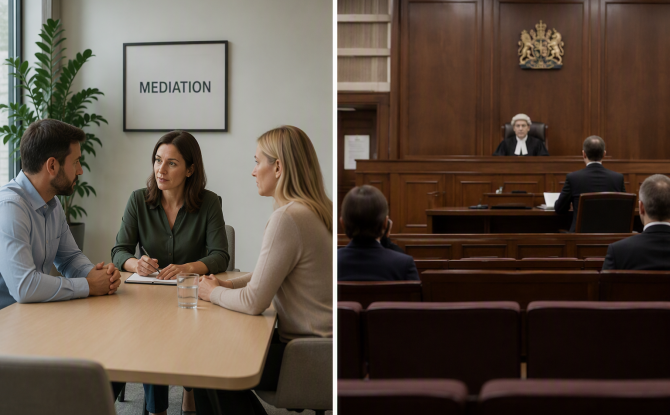
Mediation vs Court – which is better?
When a dispute arises, many people assume that going to Court is the only way to resolve it. In reality, most commercial, property, estate and business disputes are resolved without a Judge ever making a decision.
One of the most common alternatives to Court is mediation. So, which option is better? The answer depends on the circumstances, but in most cases mediation should be seriously considered before proceeding to file an action in a Court.
WHAT IS MEDIATION?
Mediation is a structured negotiation process in which an independent third party (mediator) assists the parties to the dispute to reach a mutually acceptable resolution.
Importantly, the mediator doesn’t decide who is right or wrong and does not impose a decision. Instead, they help the parties identify issues, explore options and negotiate a settlement.
Mediations can occur:
- before Court proceedings commence;
- during litigation;
- as a result of a Court order; or
- as part of dispute resolution procedures agreed by parties beforehand in their contract.
If an agreement is reached at the mediation, the terms are usually documented in a binding settlement agreement.
WHAT DOES LITIGATION ENTAIL?
Litigation involves a Court or Tribunal determining a dispute according to the law and evidence presented by the parties.
The process will generally involve:
- Pleadings (formal documents like Summons, Statement of Claim etc filed with the Court);
- Evidence (Affidavits – formal sworn witness statements);
- Subpoenas and Discovery (production of documents);
- Interlocutory applications (for procedural orders or specific pre trial issues);
- Hearing – where the Judge delivers a judgment.
Unlike mediation, a Judge makes the decision and the parties generally lose control over the outcome. Plus, the usual order is that “costs follow the cause” so if you lose, you pay the other parties’ legal costs as well as your own.
ADVANTAGES OF MEDIATION
Mediation offers several advantages to going to Court, including:
Lower cost – Litigation can be expensive. Legal costs can quickly increase as the matter progresses through pleadings, evidence, conferences and hearings. Mediation often resolves disputes before significant legal costs are incurred.
Faster resolution – Court proceedings can take many months or even years to reach a final hearing. A mediation can often be arranged within weeks and often are resolved in a single day.
Greater control – In mediation, the parties control the outcome. Rather than having a Judge impose a decision, the parties can negotiate a practical solution that suits their particular circumstances.
Confidentiality – Court proceedings are generally public. Mediation discussions are usually confidential and conducted on a “without prejudice“ basis, allowing parties to negotiate openly without fear that settlement discussions will later be used against them.
Preservation of relationships – Business partners, family members, landlords and tenants often need an ongoing relationship after the dispute is resolved. Mediation is generally less adversarial than litigation and may help preserve commercial or personal relationships.
COURT PROCEEDINGS CAN PROVIDE ADVANTAGES
Advantages of heading to Court, include:
A binding determination – Where parties are unable or unwilling to compromise, Court provides a final determination. The Judge’s decision is legally binding and enforceable.
Urgent relief – Courts can grant injunctions and other urgent orders where immediate action is required to protect assets, preserve evidence or prevent further loss.
Compulsory powers – Courts have powers that mediators do not. For example, Courts can:
- compel the production of documents (Discovery, Subpoena or Notice to Produce);
- require witnesses to attend (through Subpoenas or Notices to Attend);
- make enforceable Orders; and
- award damages and costs.
Establishing legal rights – Sometimes a party needs a clear legal ruling, particularly where an important principle or contractual interpretation is in dispute. In these cases, litigation may be unavoidable.
WHEN IS MEDIATION LIKELY TO BE BETTER?
Mediation may be particularly suitable where:
- both parties are willing to negotiate;
- the parties wish to maintain an ongoing relationship;
- confidentiality is important;
- the legal costs of litigation are disproportionate to the amount in dispute; or
- a practical solution is more important than a legal victory.
Examples of where mediations can generally assist include:
- shareholder and partnership disputes;
- commercial lease disputes;
- debt recovery matters;
- property disputes;
- neighbour disputes; and
- estate and family provision claims.
It is important to understand however, that mediation and Court are not mutually exclusive. Many disputes commence in Court and are later referred to mediation. In fact, a large proportion of civil disputes settle at mediation after the parties have exchanged evidence and have a better understanding of the strengths and weaknesses of their respective positions.
Often, commencing proceedings can provide the leverage necessary to bring the parties to the negotiating table. The best approach depends upon the nature of the dispute, the issues involved and the attitude of the parties. Obtaining early legal advice can help identify the most effective strategy and may save considerable time and cost.
FURTHER INFORMATION
Contact McKillop Legal for further information regarding commercial disputes, litigation, mediation, debt recovery or dispute resolution, contact McKillop Legal on (02) 9521 2455 or email help@mckilloplegal.com.au.
This article is general information only and is not legal advice. Specific advice should be obtained for your individual circumstances.